
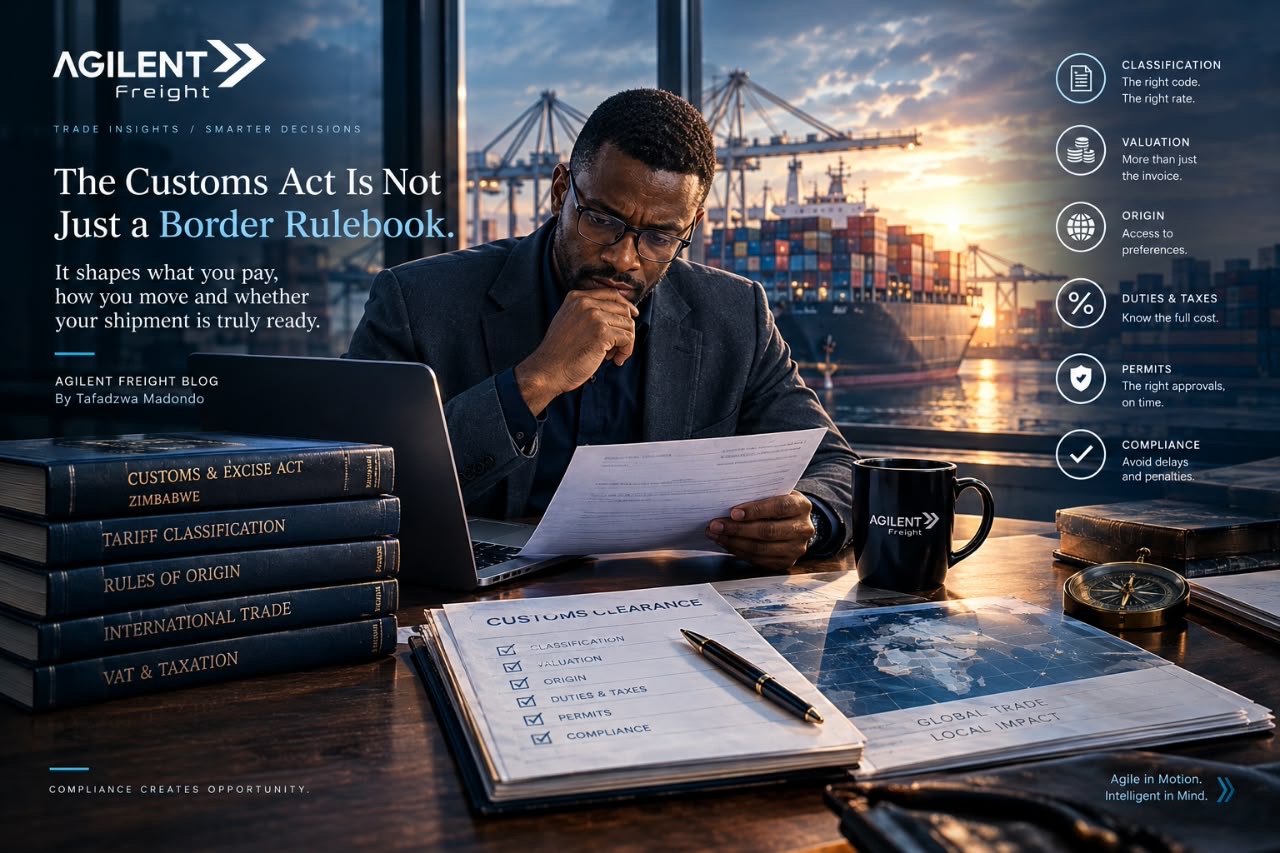
The central idea
A customs problem is often treated as a border problem because that is where it becomes visible. Its causes may lie much earlier—in product data, contract terms, valuation assumptions, origin evidence, permit planning or the allocation of responsibility for documents.
For importers, procurement leaders, finance teams and business owners operating in Zimbabwe and the wider region.
The container is at the border. The decision was made weeks ago.
Picture an ordinary import transaction. A company needs a machine component to keep production running. Procurement finds a supplier. The commercial team negotiates the price. Finance approves the payment. A logistics provider arranges the movement. Someone enters an estimated duty figure into the landed-cost spreadsheet, and the delivery date is added to the plan.
Nothing about this looks unusual. It looks like a competent business doing its job.
Then the shipment reaches a point where a question must be answered: is the product described accurately enough to support its classification? Does the declared customs value follow the applicable valuation rules? Is the origin claim supported? Are the required permits or certificates in place? Does the entry reflect the rules and measures in force for this transaction?
The goods have moved hundreds or thousands of kilometres. Yet the answer may depend on a document, a technical detail or a commercial term agreed before the first mile was travelled.
This is the first shift in perspective: customs compliance is not an administrative layer added after the commercial decision. It is one of the conditions that determines whether the commercial decision works as planned.
What the Act actually does
Zimbabwe’s Customs and Excise Act [Chapter 23:02] is part of the legal framework governing the import and export of goods, customs duties, customs procedures and related controls. It is not, however, a self-contained operating manual for every shipment. Its provisions work alongside regulations, statutory instruments, tariff measures, other legislation and applicable international obligations.
That distinction matters. Reading a section of the Act is not always enough to establish the answer to a live operational question. A regulation may prescribe a procedure; a later statutory instrument may amend a rate or condition; another law may impose a permit or product-control requirement; and the facts of the goods may determine how the rule applies.
ZIMRA describes customs valuation as operating under the Act read together with the World Trade Organization’s Customs Valuation Agreement. The wider lesson applies across customs work: identify the governing legal framework, then check the instruments and facts needed to apply it to the shipment at hand.
The disciplined question is not simply, “What does the Act say?” It is: “Which provisions and current instruments govern these goods, this transaction, this route and this date of entry?”
1. Classification: a product description is not a legal conclusion
Commercial language helps people buy and sell. Customs classification has a different job: it places goods within a defined nomenclature so the relevant tariff and other measures can be applied. The phrase on a supplier’s invoice may be commercially understandable and still be too vague to settle classification.
Consider “pump parts.” That phrase may conceal differences in material, function, design, degree of completion or the precise identity of the component. Classification cannot safely be inferred from a short label, a supplier’s habit or a code copied from a previous declaration without checking whether the goods and applicable rules are truly comparable.
Classification can affect more than the duty percentage. It may influence which restrictions, permits, trade measures or documentary requirements need to be considered. That is why a small classification assumption can affect both landed cost and shipment readiness.
The practical control is a product-level record: detailed description, technical sheet, model or part number, material and function where relevant, proposed code, rationale, source consulted and date reviewed. Revisit it when the product or applicable tariff changes. For complex or material cases, seek appropriate specialist advice or an official determination.
2. Customs valuation: the invoice is evidence, not the whole analysis
Valuation is where a common commercial instinct can lead to misunderstanding. A buyer sees the supplier invoice and assumes that the invoice amount is automatically the customs value. In many ordinary transactions, transaction value is the starting point—but customs valuation is governed by legal conditions and adjustments, not intuition alone.
ZIMRA explains that Zimbabwe generally applies a hierarchy of six valuation methods under the Act and the WTO valuation framework. The primary method is transaction value: the price actually paid or payable for goods sold for export to Zimbabwe, subject to relevant conditions and adjustments. Where that method cannot be used, the framework provides alternative methods in a prescribed order.
Depending on the transaction, matters such as freight and insurance, packing, certain commissions, assists, royalties or licence fees and other specified elements may need to be examined. The exact treatment depends on the governing provisions and facts; it is not sound practice to add or exclude an amount simply because it appears on a separate invoice line.
Imagine a business buying specialised equipment. The buyer separately pays for design work, a licence or tooling connected to production. Whether and how those amounts affect customs value is not resolved by the label attached to the payment. The legal test and transaction documents matter.
Keep the contract, commercial invoice, payment evidence, freight and insurance documents, licence arrangements and other relevant records organised. If the transaction includes related parties, unusual payment terms, royalties, assists or bundled charges, identify the valuation question early rather than waiting for a query during clearance.
3. Origin: where goods ship from is not always where they originate
Origin becomes commercially important when a business expects preferential treatment under a trade agreement or when a measure depends on origin. But origin is not necessarily established by the country from which goods were dispatched, the location of the seller or the country printed on a transport document.
Preferential origin is determined by the rules of the relevant agreement and the facts of production or processing. Those rules may distinguish goods wholly obtained in a country from goods manufactured using inputs from elsewhere, and may prescribe product-specific tests or documentary evidence.
Suppose goods are bought through a regional distributor and shipped from a neighbouring country. That route alone does not prove that the goods qualify as originating there for preferential tariff treatment. If the budget assumes a preference, the claim needs to be supported by the applicable origin rule and acceptable evidence.
Identify the origin rule before relying on the saving, ask who will provide the evidence, check that the document corresponds to the goods and transaction, and do not treat a potential preference as a confirmed saving until eligibility is established.
4. Customs control is also a question of custody, timing and procedure
The Act’s reach is not limited to the calculation of duty. Customs procedures can affect where goods may enter, how they are declared, whether they may be warehoused, how they are moved under customs control and the conditions under which they can be released or otherwise dealt with.
For a business, physical possession and legal freedom to use goods are not always the same thing. Goods may be at a warehouse or destination while still subject to customs formalities, conditions or outstanding payments. A shipment plan must recognise the difference between arrival, clearance, release and final delivery.
Warehousing and other customs procedures may offer useful cash-flow or operational options for eligible goods, but they operate under specific conditions. They should not be treated as informal storage arrangements or as a way to postpone obligations without checking the legal requirements, security conditions, records and release process.
Assign a named owner to each critical hand-off: who provides the invoice, confirms product details, obtains certificates, submits instructions, checks entry data, funds taxes and charges, and confirms release before delivery is scheduled. Ambiguity at hand-off is a preventable source of delay.
5. The legal position moves; a saved PDF does not move with it
One of the most dangerous habits in compliance is to treat a document as current because it looks official. A tariff book, saved PDF or previous declaration may help explain what was understood at a particular time. It does not necessarily establish the treatment applicable to a new shipment.
Rates, tariff measures, relief conditions, procedures and controls can be changed through later legal instruments. The product, date of entry and transaction facts also matter. A reliable check therefore needs a date and a source, not simply a remembered answer.
For Zimbabwe, use current ZIMRA tariff and customs guidance as a starting point, then verify the applicable legislation and subsequent statutory instruments. ZIMRA’s tariff handbook page identifies the Customs and Excise Tariff Notice 2022; the existence of that handbook does not remove the need to check later amendments and measures relevant to the specific goods.
Good records show not only the conclusion but how it was reached: the code considered, valuation basis, origin evidence, current measure checked, date of review, unresolved questions and person who approved the decision. That turns compliance from institutional memory into a repeatable process.
A practical control: the one-page customs brief
For each material or unfamiliar import, prepare a short internal brief before dispatch. It need not be elaborate; it should make the critical assumptions visible.
- Goods identity: precise description, model, technical specifications, material and function where relevant.
- Classification: proposed tariff code, reasoning, reference source, date checked and unresolved technical questions.
- Valuation: invoice and contract basis, payment terms, freight and insurance evidence, and any royalties, assists, commissions or related-party considerations requiring review.
- Origin: country of origin, agreement or preference being considered, applicable origin rule and evidence owner.
- Controls: permits, certificates, inspections, licences or other commodity-specific requirements confirmed with the relevant authority or qualified specialist.
- Cost model: duty, surtax, VAT and other applicable charges shown as separate assumptions, with unknowns marked as unknown rather than silently set to zero.
- Execution: document owner, deadline, customs-entry responsibility, payment readiness, release confirmation and delivery plan.
The point is not paperwork for its own sake. It is to ensure that purchasing, finance and logistics are working from the same assumptions—and can see which assumptions remain unverified.
A short example: the cost of an untested assumption
Suppose a business imports equipment and its financial model assumes a particular tariff classification and duty treatment. The buying decision is approved on that basis. Later, the classification or treatment is found to require further review, changing the estimated duty or documentary path.
The immediate effect may be a revised cost estimate. The second-order effects can matter just as much: a selling price that no longer protects the margin, a customer delivery promise that needs renegotiation, extra working capital tied up in the transaction, or production planning that must be adjusted.
No specific rate or outcome can be inferred from this hypothetical. The point is decision quality: when an assumption materially affects the economics of a transaction, test it before committing to a price, date or cash requirement that depends on it.
What this means for management
Customs should not sit exclusively with the person who prepares the entry. The declaration may be completed by a customs agent, but the underlying information is generated across the business: procurement negotiates the terms; engineering knows what the product is; finance knows the payment structure; the supplier holds technical and origin documents; logistics coordinates the movement; and management owns the commercial commitments.
A mature process gives each function a clear role. It distinguishes facts that are known, conclusions that have been checked, and assumptions that still need confirmation. That distinction is modest, but powerful. It helps the business decide where to spend attention and when a shipment is not yet ready to move.
The long-term opportunity is not to eliminate every uncertainty. That is unrealistic. It is to detect material uncertainty early enough to preserve options: ask the supplier for better specifications, clarify a contract term, obtain the correct document, verify tariff treatment, revise the budget or adjust the route and timing.
Where a capable freight partner adds value
A logistics partner cannot replace the importer’s legal responsibilities, a customs authority’s determination or the work of a qualified customs or tax specialist. Nor should a freight provider imply that every classification or compliance issue can be settled from a brief email.
The useful contribution is disciplined coordination. A capable partner helps establish what information is available, what is missing, which hand-offs could create operational risk, and which questions need to be referred to the appropriate specialist or authority before dispatch. It connects the movement plan with the documentary and commercial dependencies that determine whether the movement can be completed as intended.
That is the perspective Agilent Freight brings to import planning: not to make the transaction look more complicated than it is, but to identify the details that could materially change its cost, timing or readiness. For some shipments, this will confirm that the plan is sound. For others, it will reveal a question worth resolving while the business still has room to act.
The deeper lesson
A customs declaration is the visible end of a chain of decisions. Its quality depends on what the business knew, what it documented, what it verified and what it assumed before the goods moved.
The Customs and Excise Act is therefore not merely a border rulebook. It is part of the operating environment in which an import must make commercial sense. It shapes how goods are described, how value is established, how origin claims are supported, how procedures are followed and how goods are released.
The mature response is neither fear nor overconfidence. It is to understand the legal framework, check the current instruments, retain evidence and resolve material questions early. Where the facts or law are uncertain, say so—and seek the right determination rather than forcing a convenient answer.
The best time to discover a customs question is usually when the purchase order can still be changed, the supplier can still provide evidence and the shipment plan can still be adjusted.
By the time the cargo is waiting, the same question may have become much more expensive.
Sources and scope
This article is general trade and logistics information, not legal, tax or customs advice for a specific shipment. Zimbabwe’s Customs and Excise Act [Chapter 23:02] must be read with current amendments, applicable statutory instruments, the tariff in force, other relevant laws and the facts of the transaction. Confirm classification, valuation, origin, rates, permits and procedures with current official sources and appropriate qualified professionals before relying on a conclusion.
Useful starting points for further verification:
- ZIMRA — Customs valuation system: View official source
- ZIMRA — Tariff handbook: View official source
- ZIMRA — Customs and Excise Act [Chapter 23:02]: View official source
- ZIMRA — Customs valuation manual: View official source
Tafadzwa Madondo
Agilent Freight · Agile in Motion. Intelligent in Mind.
Read the first trade intelligence letter